
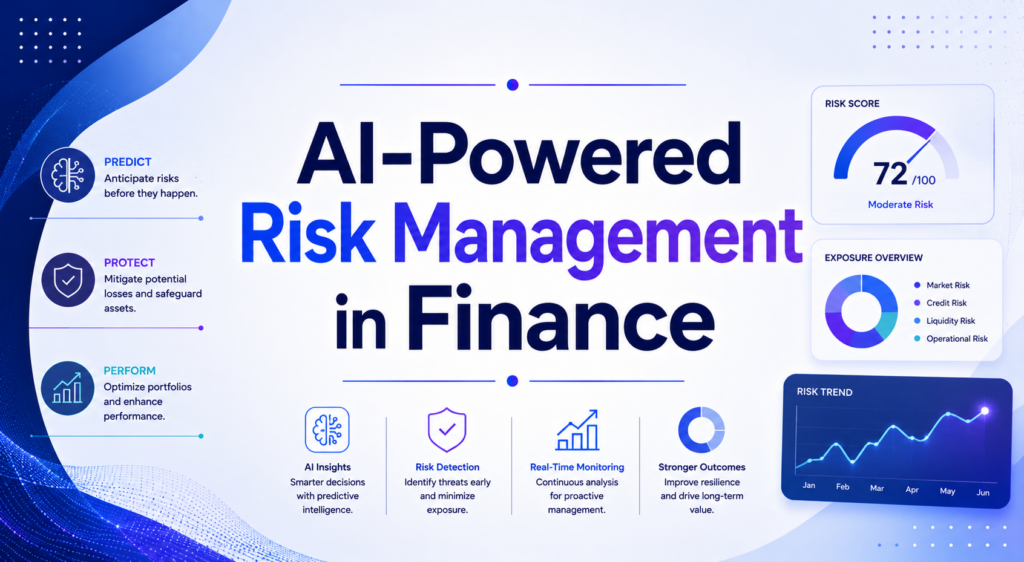
Risk management has always been the cornerstone of financial services, but artificial intelligence has fundamentally changed what is possible in this domain over the past five years. Financial institutions in 2026 are deploying machine learning models that identify credit risk, detect fraud, manage market risk, and ensure regulatory compliance at speeds and scales that were impossible with traditional statistical approaches. Understanding how AI-powered risk management works, where it excels, and where it still requires human judgment is essential for anyone operating in or investing in the financial services sector.
Credit Risk Assessment: From FICO Scores to Machine Learning
Traditional credit risk assessment relied primarily on credit scores, debt-to-income ratios, and employment history — a limited set of variables that excluded large portions of the population from credit access and sometimes failed to accurately predict default risk. Machine learning has expanded the variable set dramatically while improving predictive accuracy.
Alternative Data in Credit Scoring
Modern AI credit models incorporate hundreds or thousands of variables beyond traditional credit data: rental payment history, utility payment records, educational background, professional history from LinkedIn, even device and behavioral data from mobile applications. This expansion of the credit signal has improved default prediction accuracy while also extending credit access to thin-file consumers who lack traditional credit history.
Explainability Requirements Under Regulation
The Equal Credit Opportunity Act and GDPR’s right to explanation create legal requirements for lenders to explain adverse credit decisions. Early machine learning credit models faced regulatory challenges because neural networks were effectively black boxes. The 2026 generation of credit AI uses explainable AI (XAI) techniques — particularly SHAP values and LIME — that identify the specific factors driving each decision, satisfying both regulatory requirements and internal model governance standards.
Fraud Detection: Real-Time Machine Learning at Scale
Payment fraud detection is perhaps the most mature and successful application of AI in financial risk management. Systems processing millions of transactions per day make real-time approval or decline decisions in under 50 milliseconds using machine learning models that continuously update based on emerging fraud patterns.
Graph Neural Networks in Fraud Detection
The most sophisticated 2026 fraud detection systems use graph neural networks that model the relationships between accounts, devices, merchants, and IP addresses rather than evaluating each transaction in isolation. This network-aware approach identifies fraud rings and synthetic identity fraud that transaction-level models miss, because the fraudulent behavior is visible in the connection pattern rather than any individual transaction.
Adversarial Machine Learning: The Fraud Arms Race
Fraud detection is an adversarial problem — fraudsters continuously adapt their behavior to evade detection models. This creates a continuous model update requirement. Institutions with the most sophisticated fraud AI programs have shifted from static models updated quarterly to online learning systems that update continuously based on confirmed fraud labels, often maintaining lead time over emerging fraud patterns of days rather than months.
Market Risk and Portfolio Management
Market risk quantification — measuring how much a portfolio could lose in adverse market conditions — has been transformed by AI’s ability to model complex, non-linear relationships between asset classes and market factors.
Neural Network Value at Risk Models
Traditional Value at Risk (VaR) models assumed normally distributed returns and linear factor relationships, both of which failed catastrophically during market stress events like 2008 and 2020. Deep learning VaR models capture fat-tail distributions, non-linear factor exposures, and cross-asset contagion dynamics that traditional parametric models missed, producing more accurate tail risk estimates that hold up better during actual market stress.
AI in Liquidity Stress Testing
Regulatory stress testing requirements (Basel III, DFAST) require financial institutions to model their balance sheet under severe but plausible economic scenarios. Machine learning models trained on historical stress episodes generate more realistic and institution-specific stress scenarios than the deterministic regulatory scenarios mandated by regulators, giving risk managers better insight into actual vulnerability.
AI Risk Management Applications in Finance
| Application | Maturity Level | Key Technology | Primary Benefit | Regulatory Status |
|---|---|---|---|---|
| Credit scoring | Very High | Gradient boosting, XAI | Accuracy + access | Approved with explainability |
| Fraud detection | Very High | Graph neural networks | Real-time, adaptive | Approved |
| Market risk | High | Deep learning, Monte Carlo | Tail risk accuracy | Approved with validation |
| AML/Compliance | High | NLP, network analysis | False positive reduction | Approved with audit |
| Systemic risk | Medium | Agent-based modeling | System-wide view | Research/emerging |
Anti-Money Laundering: AI Reduces False Positives
AML compliance has historically generated enormous numbers of false positive alerts that consumed compliance team resources while missing actual illicit activity. Traditional rules-based AML systems flagged approximately 95-99% of alerts as false positives, creating alert fatigue and investigation backlogs.
Machine Learning AML Models
AI-powered AML systems use network analysis, transaction pattern recognition, and natural language processing on transaction descriptions to dramatically reduce false positive rates while maintaining or improving detection of genuine money laundering activity. Leading implementations report 50-80% reductions in false positive alerts with equal or superior detection rates.
Regulatory Landscape for AI Risk Management in 2026
Regulators globally have developed frameworks for AI use in financial services that require model documentation, validation, fair lending testing, and ongoing monitoring. The Federal Reserve, OCC, and EU’s AI Act all impose specific requirements on financial institutions using AI in risk decisions.
Model Risk Management (SR 11-7)
The Federal Reserve’s SR 11-7 guidance on model risk management applies to all quantitative models used in risk decisions, including machine learning models. Requirements include model documentation, independent validation, ongoing performance monitoring, and board-level oversight of model risk governance. Institutions using AI in credit, market risk, or compliance decisions must integrate these models into their model risk management framework.
Frequently Asked Questions
Can AI replace human risk managers at banks?
No, and this is not the direction most institutions are moving. AI augments human risk managers by automating routine analysis, flagging anomalies, and processing data volumes impossible for humans to analyze manually. Strategic risk judgment, regulatory relationship management, and decisions in novel situations still require human expertise and accountability.
What is the biggest risk of using AI in financial risk management?
Model risk — the risk that AI models perform well historically but fail in new market conditions or adversarial environments — is the primary concern. AI models trained on historical data can develop spurious correlations that break down during structural market changes. This is why model validation, stress testing, and ongoing monitoring are regulatory requirements rather than optional best practices.
How are smaller banks and credit unions using AI for risk management?
Smaller institutions typically access AI risk management capabilities through vendor platforms and fintech partnerships rather than building in-house. Companies like Zest AI, Upstart, and Provenir provide AI credit risk models that smaller institutions license, gaining access to machine learning capabilities without requiring internal data science teams.
Conclusion
AI-powered risk management in financial services has moved from experimentation to production deployment across credit, fraud, market risk, and compliance domains. The institutions gaining competitive advantage are those that have invested in data infrastructure, model governance frameworks, and the human expertise needed to deploy and oversee AI models responsibly. The technology is proven; the differentiator in 2026 is the organizational capability to use it at scale while maintaining the regulatory compliance, explainability, and human oversight that financial services demand.