
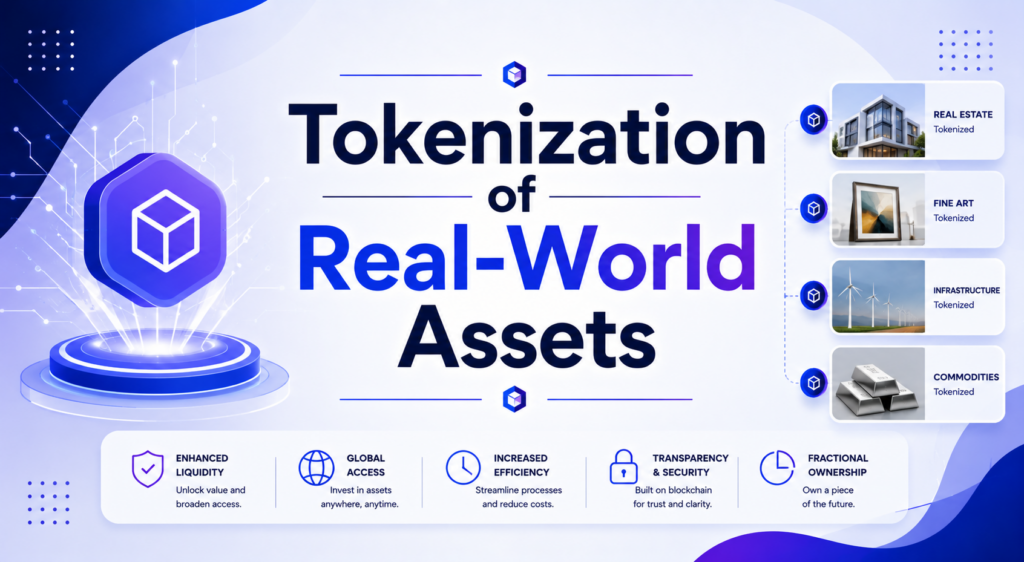
Tokenization of real-world assets (RWA) has emerged as one of the most significant structural changes in global capital markets since the introduction of ETFs. In 2026, tokenization — the process of representing ownership of physical or financial assets as digital tokens on a blockchain — has moved well beyond proof-of-concept into regulated, institutional-scale deployment. Major financial institutions including BlackRock, Franklin Templeton, JPMorgan, and Goldman Sachs have active tokenized asset programs, and the total value of tokenized real-world assets exceeded $12 billion in early 2026 and is growing rapidly. Understanding this shift is increasingly essential for sophisticated investors and finance professionals.
What Is Real-World Asset Tokenization?
Real-world asset tokenization creates a digital representation of ownership in a physical or financial asset on a blockchain. The token holder has a legal claim to the underlying asset, enforced through smart contracts and, critically, through legal structures that connect the on-chain token to off-chain legal ownership.
How Tokenization Works Technically
The process begins with a legal structure that separates the asset into a special purpose vehicle (SPV) or trust. Token holders are beneficial owners of the SPV’s assets. Smart contracts on a blockchain encode ownership rights, transfer rules, income distribution, and compliance requirements. The result is an asset that can be transferred instantly, fractionalized to any degree, and traded on secondary markets while maintaining a clear audit trail of ownership history.
Permissioned vs. Public Blockchains
Most institutional RWA tokenization in 2026 uses permissioned blockchains (Hyperledger Fabric, JPMorgan’s Onyx, Broadridge’s blockchain infrastructure) or permissioned layers on public blockchains (Ethereum with permissioned access controls). This architecture satisfies institutional requirements for KYC/AML compliance and regulatory oversight while preserving the settlement efficiency benefits of blockchain.
Asset Classes Being Tokenized in 2026
The spectrum of assets being tokenized has expanded dramatically. What started primarily with real estate has extended to virtually every investable asset class.
Tokenized US Treasuries
Tokenized US Treasury bills have been the fastest-growing RWA category in 2026. Products from BlackRock (BUIDL), Franklin Templeton (FOBXX), and Ondo Finance offer on-chain exposure to short-term US government debt. These products appeal to crypto-native funds and DAOs that want yield-generating positions without exiting the blockchain ecosystem.
Private Credit and Trade Finance
Tokenized private credit — loans to private companies structured as tradeable tokens — addresses the liquidity gap in traditional private credit markets. Figure Technologies and Maple Finance are among the platforms bringing tokenized private credit to institutional and accredited investors, with secondary market liquidity that was previously unavailable in this asset class.
Real Estate Tokenization
Commercial and residential real estate tokenization allows fractional ownership of individual properties or real estate portfolios, lowering minimum investment thresholds from $100,000+ to $500-$1,000 per token on regulated platforms. RealT, Lofty, and institutional platforms like CBRE’s tokenization program represent different segments of this market.
Real-World Asset Tokenization Platforms Compared
| Platform | Asset Class | Investor Type | Min. Investment | Regulatory Status |
|---|---|---|---|---|
| BlackRock BUIDL | US Treasuries | Institutional | $5 million | SEC-registered |
| Franklin Templeton FOBXX | US Treasuries/Money Market | Institutional | Varies | SEC-registered |
| Ondo Finance | US Treasuries | Accredited | $5,000 | Regulated |
| RealT | US Real Estate | Accredited/Retail | $50 | Regulated (SEC Reg D/S) |
| Maple Finance | Private Credit | Institutional | $100,000 | Regulated |
Investor Benefits of Tokenized Assets
Tokenization offers structural improvements over traditional asset structures that benefit investors across multiple dimensions.
Fractional Ownership and Access
Tokenization reduces minimum investment thresholds for traditionally illiquid or high-minimum assets. A $50 million commercial property can be divided into millions of tokens at $50 each, providing access to institutional-quality real estate for investors who would otherwise be excluded.
24/7 Settlement and Liquidity
Traditional securities settlement takes T+2 (two business days). Tokenized securities settle in seconds or minutes on-chain, reducing counterparty risk and freeing up capital currently tied up in the settlement process. Secondary markets for tokenized assets can operate 24/7 across time zones, unlike traditional exchanges.
Automated Compliance and Corporate Actions
Smart contracts can automate dividend distribution, investor KYC/AML compliance checks, transfer restriction enforcement, and tax reporting — reducing administrative costs and errors associated with manual processes in traditional securities administration.
Regulatory Landscape for RWA Tokenization
The regulatory framework for tokenized real-world assets has clarified significantly in 2026, particularly in the US, EU, and Singapore, where specific regulatory frameworks for digital asset securities now exist.
US Regulatory Status
The SEC has provided guidance that tokenized securities are subject to existing securities laws and must be issued under appropriate exemptions (Reg D for accredited investors, Reg A+ for broader retail access, or full S-1 registration for public offerings). The lack of a specific tokenized securities regulatory framework means issuers must navigate existing structures, but the path is now well-established for compliant issuance.
Frequently Asked Questions
Are tokenized assets safe investments?
The safety of a tokenized asset depends primarily on the underlying asset and the legal structure connecting the token to it — not the tokenization technology itself. A tokenized US Treasury is as safe as a direct Treasury investment; a tokenized stake in a speculative real estate development carries that development’s risk. Smart contract risk and platform risk are additional considerations unique to tokenized assets.
How are tokenized asset returns taxed?
In the US, the IRS treats tokenized securities as the underlying asset type for tax purposes. Tokenized stock dividends are taxed as dividend income; tokenized real estate income is taxed as real estate income. The tax treatment follows the underlying asset, not the token wrapper.
What is the difference between tokenized assets and cryptocurrency?
Tokenized real-world assets represent claims on identifiable off-chain assets with legal enforceability. Cryptocurrencies like Bitcoin and Ethereum are native digital assets with value independent of any off-chain claim. The distinction is fundamental: tokenized assets’ value is derived from underlying real-world assets; cryptocurrency values are determined by market dynamics independent of physical assets.
Conclusion
Real-world asset tokenization is transitioning from an emerging technology to infrastructure for global capital markets. The participation of major asset managers, the development of regulatory frameworks, and the proven utility of tokenized Treasuries as the first institutional-scale use case have validated the model. For investors and financial professionals, understanding tokenization is no longer optional — it is becoming as fundamental as understanding ETFs was in the 2000s. The efficiency gains in settlement, the access democratization through fractionalization, and the programmable compliance infrastructure represent structural improvements that are compelling enough to drive long-term institutional adoption regardless of cryptocurrency market cycles.