
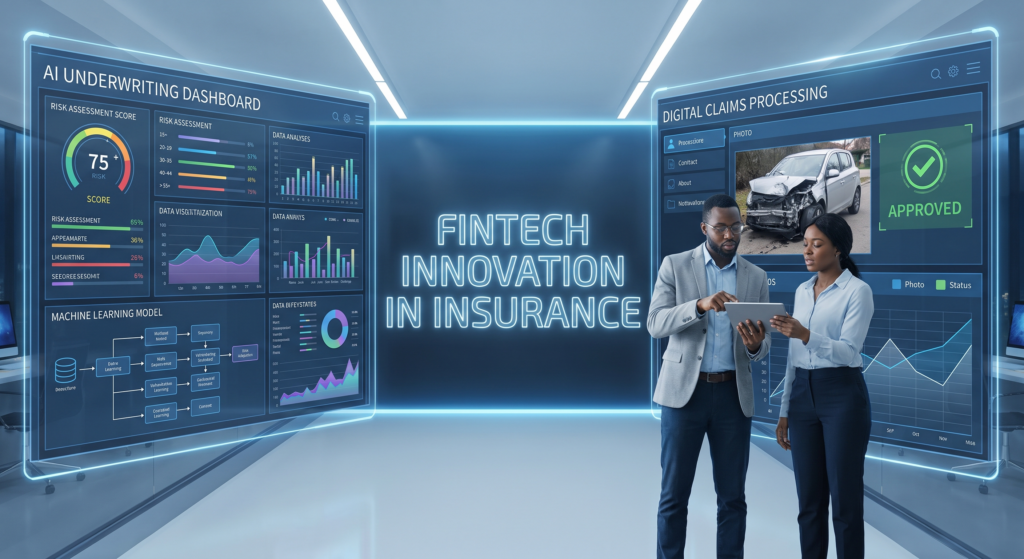
Insurance has long been one of the most data-intensive industries in finance — and one of the slowest to modernize. The combination of regulatory complexity, actuarial tradition, and massive legacy infrastructure has historically made insurance resistant to the technological disruption that transformed banking and investment management. In 2026, that resistance is finally breaking down. AI and machine learning are reshaping insurance underwriting, claims processing, fraud detection, and pricing at a pace that’s catching even industry insiders off guard. This analysis examines where AI is creating the most value in insurance — and where the most significant risks lie.
The Insurance Data Advantage
Insurance companies sit on enormous datasets that make them uniquely positioned to benefit from machine learning. Historical claims data, policy information, telematics feeds, medical records (with appropriate consent frameworks), property data, and behavioral signals have accumulated over decades, creating training datasets that most industries can only dream of.
Why Now: Enabling Conditions for AI in Insurance
Three factors have converged to accelerate AI adoption in insurance in 2025–2026. Cloud computing has made it economically feasible to process the massive datasets insurance requires. Regulatory frameworks in the EU, UK, and US have evolved to address algorithmic decision-making in financial services, giving compliance teams clearer guidance. And competitive pressure — from insurtechs like Lemonade, Root, and Hippo — has forced traditional carriers to modernize or lose market share to more nimble digital-first competitors.
AI in Underwriting: From Actuarial Tables to Dynamic Risk Models
Traditional underwriting relies on actuarial models built from historical data and segmented into broad risk categories. Machine learning enables far more granular risk assessment — moving from “male driver, age 25-30, urban” to models incorporating hundreds of behavioral and contextual variables.
Motor Insurance: Telematics and Behavioral Pricing
Telematics-based underwriting — using data from smartphone apps or in-car devices to assess driving behavior — is among the most mature applications of AI in insurance. Progressive’s Snapshot, Allstate’s Drivewise, and numerous European carriers use ML models to process telematics data (acceleration patterns, braking behavior, cornering, time of day, mileage) into real-time risk scores. Research consistently finds that behavioral telematics data is more predictive of claims than traditional demographic variables, particularly for younger drivers.
Property Insurance: Satellite and Computer Vision
Computer vision applied to satellite imagery is transforming property underwriting. AI can now assess roof condition, vegetation proximity, pool presence, and structural characteristics from aerial imagery — without requiring physical inspection. Companies like Cape Analytics and Nearmap provide insurers with AI-processed property intelligence that reduces underwriting time from days to minutes and improves accuracy. For flood and wildfire risk, AI models integrating climate data, topography, and vegetation density are producing risk assessments that traditional actuarial models couldn’t approach.
Life and Health Insurance: Predictive Health Models
AI applications in life and health underwriting are the most regulated and most sensitive. Machine learning models that incorporate electronic health record data, wearable device data, and genomic information can predict mortality and morbidity risk with substantially higher accuracy than traditional underwriting questionnaires. The regulatory and ethical questions — particularly around potential discrimination and privacy — are significant and vary substantially across jurisdictions. The EU’s AI Act places AI health underwriting tools in a high-risk category requiring specific conformity assessments.
AI in Claims Processing: From Weeks to Minutes
Claims processing is where AI is delivering some of insurance’s most dramatic efficiency gains. Traditional claims handling involves manual documentation review, adjuster inspection, third-party verification, and extensive human judgment at each step. AI is compressing this timeline from weeks to days or hours.
Automated First Notice of Loss (FNOL)
| Claim Type | Traditional Timeline | AI-Assisted Timeline | Automation Rate (2026) |
|---|---|---|---|
| Simple auto claims | 7–14 days | 24–72 hours | 60–80% |
| Property damage | 14–30 days | 3–7 days | 40–60% |
| Health claims (routine) | 10–20 days | Same day | 85–95% |
| Complex liability | 3–12 months | 4–8 weeks | 10–20% |
Computer Vision for Damage Assessment
Companies like Tractable use computer vision models trained on millions of damage photos to estimate repair costs from photos submitted via smartphone apps. When a policyholder photographs vehicle damage and uploads it through an app, the AI system can produce a preliminary repair estimate within minutes, compare it to labor and parts databases, and either auto-approve claims below threshold values or flag them for human review. Tractable reports that their AI can assess repair costs with accuracy within 5–10% of human adjuster estimates for standard damage types.
Natural Language Processing for Documentation
Insurance claims generate substantial unstructured text — police reports, medical records, adjuster notes, legal filings. NLP models can extract key information from these documents, classify claims by type and complexity, identify relevant policy provisions, and summarize the information for human reviewers. This reduces the manual documentation review time that has historically been one of the biggest bottlenecks in complex claims handling.
Dynamic Pricing and Personalization
Traditional insurance pricing updates annually or biannually based on actuarial review. AI enables continuous dynamic pricing — adjusting premiums in response to real-time behavioral data and market conditions.
Usage-Based Insurance (UBI)
Usage-based insurance products — where premiums reflect actual usage and behavior rather than fixed annual rates — are among the most compelling consumer applications of AI in insurance. Pay-per-mile auto insurance uses GPS data to charge based on actual mileage driven. Pay-how-you-drive products adjust premiums monthly based on behavioral scores. For low-mileage drivers or safe drivers, these products can reduce premiums by 20–40%, creating significant consumer value while giving carriers more accurate risk pricing.
Regulatory and Ethical Considerations
AI in insurance raises significant regulatory and ethical questions that investment analysts and industry participants must understand.
Algorithmic Discrimination Risk
ML underwriting models can inadvertently encode historical discrimination into algorithmic decisions — proxies for race, ethnicity, or gender can emerge from seemingly neutral variables like ZIP code, occupation, or education level. Regulators in multiple jurisdictions are increasingly requiring explainability (the ability to explain why a specific underwriting or pricing decision was made to the affected consumer) and disparate impact testing (verifying that AI models don’t produce systematically different outcomes for protected classes).
Model Risk Management
Financial regulators increasingly require formal model risk management (MRM) frameworks for AI systems used in material financial decisions. This includes model validation, ongoing monitoring, documentation requirements, and fallback procedures. The operational overhead of compliant AI deployment in regulated insurance markets is substantial — a competitive advantage for large carriers with the compliance infrastructure to manage it at scale.
Frequently Asked Questions
Which insurance lines are most disrupted by AI?
Personal auto insurance (telematics, claims automation) and health insurance (claims processing, prior authorization) have seen the most AI disruption to date. Commercial property and specialty lines are earlier in the adoption curve but showing accelerating momentum as data quality and model maturity improve.
Are AI-driven insurance models more accurate than traditional actuarial models?
For specific, well-defined risk assessment tasks with abundant training data, yes — significantly. For complex, rare risks with limited historical data, traditional actuarial methods often remain competitive. The practical answer is that hybrid approaches — combining statistical actuarial foundations with ML enhancements — outperform either method alone for most insurance applications.
What’s the investment opportunity in insurance AI?
The global insurtech market is projected to reach $166 billion by 2030 (CAGR ~35%). Investment opportunities span pure-play insurtechs building AI-native insurance products, enabling technology vendors providing AI infrastructure to traditional carriers, and traditional carriers with demonstrated AI adoption track records and the scale to sustain competitive models. Early-stage risk is high; the regulatory and capital requirements create significant barriers that not all insurtechs will clear.
How is AI changing insurance distribution?
AI is improving lead quality through better propensity modeling, enabling chatbot-based quote and purchase flows that reduce acquisition costs, and supporting agent productivity through better customer insights and cross-sell recommendations. The broker and independent agent model remains robust — AI is enhancing rather than replacing distribution networks in most segments.
Conclusion
AI in insurance is moving from pilot to production at accelerating pace, driven by the combination of data availability, improved model capabilities, and competitive pressure from technology-native entrants. The carriers and insurtechs that are building genuine AI competency — in underwriting accuracy, claims efficiency, and fraud detection — are creating durable competitive advantages. For investors, the insurance AI space offers compelling opportunities alongside meaningful risks: regulatory uncertainty, data quality challenges, and the substantial capital requirements of building AI systems that meet the accuracy and explainability standards that insurance decisions demand.