
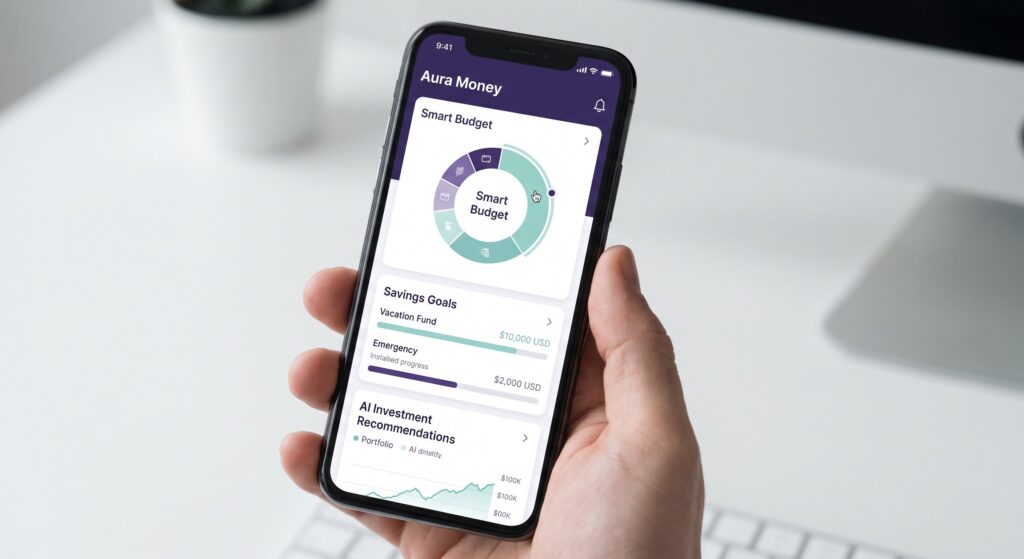
Personal finance has traditionally been reactive—people look at bank statements after the fact, create budgets they struggle to maintain, and make investment decisions based on general rules of thumb rather than their specific situation. AI-powered personal finance tools are changing this equation, using machine learning to provide proactive, personalized financial guidance that adapts to individual behavior patterns and goals. The result is smarter budgeting, automated savings, and investment recommendations that improve over time as the system learns more about you.
How AI Transforms Personal Finance Management
Traditional personal finance apps are essentially sophisticated spreadsheets—they record what happened and display it visually. AI-powered tools go further: they predict what will happen, identify patterns in your behavior, and proactively suggest actions that align with your financial goals.
Machine Learning Capabilities in Personal Finance
- Transaction categorization: Automatically classify spending into categories with 95%+ accuracy
- Pattern recognition: Identify recurring expenses, unusual charges, and spending trends
- Cash flow prediction: Forecast account balances based on historical income and spending patterns
- Goal optimization: Recommend savings rates and allocation strategies based on individual goals and timelines
- Behavioral nudges: Deliver personalized insights at moments when they’re most actionable
- Anomaly detection: Flag unusual transactions that may indicate fraud or billing errors
Why AI Outperforms Generic Financial Advice
Generic personal finance advice (save 20% of income, maintain a 6-month emergency fund, invest in index funds) applies to a statistical average that matches few individuals precisely. AI tools analyze your specific income patterns, spending behavior, debt situation, and goals to provide recommendations calibrated to your actual life—not a theoretical average consumer.
AI Budgeting and Expense Tracking
Budgeting is the foundation of personal finance, and AI makes it dramatically more effective than traditional envelope systems or manual spreadsheets.
Automatic Transaction Categorization
AI budgeting tools connect to bank accounts and credit cards via open banking APIs, automatically importing and categorizing every transaction. Modern NLP models achieve 95%+ accuracy in categorization, handling edge cases that trip up simpler rule-based systems (Is “DoorDash” food delivery or subscription? The AI checks transaction patterns to determine the correct category).
Dynamic Budget Recommendations
Rather than requiring you to manually set budgets for every category, AI tools analyze your spending history and recommend budgets based on your actual behavior and stated goals. “You typically spend $340/month on dining. Based on your savings goal for a house down payment in 18 months, reducing to $280/month would let you reach your goal 2 months earlier—here are the specific restaurants where you could cut back.” This specificity is what makes AI-powered budgeting actionable.
Proactive Cash Flow Alerts
AI tools that connect to your accounts can predict when your balance will run low before it happens: “Based on your typical spending patterns and your rent payment on the 1st, your checking account will likely reach $200 on July 29th. Would you like to transfer $500 from savings?” These proactive alerts prevent overdrafts and the associated fees.
AI-Powered Savings Automation
The most effective personal finance AI tools don’t just provide insights—they take action on your behalf. AI-powered savings automation removes the friction of manual saving decisions.
Behavioral Economics-Based Savings
Apps like Digit and Qapital pioneered AI-driven micro-savings: analyzing your account daily and automatically transferring small amounts to savings when you can afford it without risk of overdraft. The amounts are too small to feel significant (often $5-$35 per transfer) but accumulate meaningfully over time. Users of these apps save 25-40% more than those using traditional manual savings methods.
Round-Up Investing
Acorns and similar apps round up every purchase to the nearest dollar and invest the difference in diversified portfolios. The AI determines the optimal portfolio allocation based on your risk tolerance, time horizon, and financial situation, and automatically rebalances as your portfolio grows. While the amounts are small, the behavioral effect is significant: round-up investors develop consistent savings habits that they often scale up over time.
AI Investment and Robo-Advisory Platforms
Robo-advisors use AI to deliver investment management services that were previously accessible only to wealthy clients of private wealth managers.
Portfolio Construction and Optimization
Robo-advisors use Modern Portfolio Theory and optimization algorithms to construct diversified portfolios that maximize expected return for a given risk level. They account for tax efficiency (asset location—placing tax-inefficient assets in tax-advantaged accounts), transaction costs, and rebalancing frequency in ways that would be computationally impractical to do manually for individual portfolios.
Tax-Loss Harvesting at Scale
Betterment and Wealthfront offer daily tax-loss harvesting—automatically selling positions that have declined in value to realize tax losses (which offset gains elsewhere), while immediately reinvesting in similar (but not substantially identical) securities to maintain market exposure. This service, worth thousands of dollars annually for portfolios above $100K, is now available to investors at any wealth level.
Goal-Based Financial Planning
Modern AI financial platforms allow users to define multiple financial goals (retirement at 60, child’s college fund, house down payment in 5 years) and automatically allocate contributions and investment strategies to optimize for all goals simultaneously, updating recommendations as circumstances change.
AI Personal Finance Tools Comparison
| Tool | Primary Focus | Key AI Feature | Cost | Best For |
|---|---|---|---|---|
| Monarch Money | Budgeting, net worth | AI categorization, predictions | $14.99/mo | Comprehensive financial overview |
| Copilot | Budgeting, spending insights | ML categorization, trends | $13/mo | Mac/iPhone users |
| Betterment | Investing, retirement | Tax-loss harvesting, optimization | 0.25% AUM/yr | Hands-off investors |
| Wealthfront | Investing, planning | Path financial planning, TLH | 0.25% AUM/yr | Comprehensive financial planning |
| Acorns | Micro-investing, savings | Round-up investing, Found Money | $3-$9/mo | New investors building habits |
| Digit | Automated savings | Behavioral savings AI | $5/mo | People who struggle to save |
Privacy and Security Considerations
AI personal finance tools require access to sensitive financial data. Understanding the security and privacy implications is essential before connecting your accounts.
How Data Is Protected
Reputable personal finance AI tools use read-only access to financial accounts (they can see data but cannot initiate transactions except where explicitly authorized). Data is encrypted in transit and at rest. Connections to banks are established through secure API partners like Plaid or MX rather than requiring actual login credentials.
What to Check Before Using Any Tool
- Does the app use read-only API connections or store your bank credentials?
- Is data encrypted and what’s the retention policy?
- Is the company regulated (FINRA, SEC, or state-level) for investment recommendations?
- What happens to your data if the company is acquired?
Frequently Asked Questions
Are AI financial planning tools as good as a human financial advisor?
For investment management and routine financial planning, robo-advisors often outperform human advisors on an after-fee basis because their lower costs more than offset any performance difference. For complex situations (estate planning, business exits, complex tax situations), human advisors with fiduciary duty add significant value that AI cannot replicate.
How much money do I need to start using a robo-advisor?
Most robo-advisors have low or no minimum investment requirements. Betterment has no minimum, Wealthfront requires $500, and Schwab Intelligent Portfolios requires $5,000. Acorns and Stash allow investing with as little as $1.
Are my investments safe in a robo-advisor?
Yes. Regulated robo-advisors hold client assets in SIPC-insured brokerage accounts (up to $500,000 in securities). They are separate from the robo-advisor company’s own assets—if the company fails, your investments are protected.
Can AI tools really help me save more money?
Research consistently shows yes. Studies of Digit users found average savings of $2,000-$3,000 more per year than control groups using traditional manual saving. The mechanism is behavioral: AI automation removes the decision friction that causes most people to defer or skip saving.
Should I trust AI-generated financial advice?
For straightforward financial decisions (portfolio allocation, savings rate, budgeting), AI recommendations from reputable platforms are sound and evidence-based. For complex situations, treat AI guidance as a starting point for informed discussion with a human fiduciary advisor.
Conclusion
AI is democratizing financial services—delivering investment management, tax optimization, and personalized financial planning to individuals who previously couldn’t access or afford these services. Whether it’s automated micro-savings that build habits without willpower, robo-advisors that manage diversified portfolios with institutional-grade optimization, or AI budgeting tools that provide proactive insights rather than reactive reports, machine learning is making it easier than ever to make smart financial decisions. The technology is only getting better—and the gap between having AI-powered financial tools and not is likely to translate into meaningfully different financial outcomes over a lifetime.