
For a decade, “crypto payments” mostly meant one thing: a coffee shop that briefly accepted Bitcoin for publicity, then stopped. The consumer story never quite worked. Prices moved too fast, checkout was clumsy, and nobody wanted to spend an asset they expected to go up.
The B2B story is different, and it’s happening with far less noise. A growing set of startups now let businesses pay for shipping labels, freight, customs brokerage and last-mile delivery in Bitcoin, Ethereum and stablecoins. No press release, no token launch — just a payment option that solves a real operational problem for a specific kind of customer.
This piece looks at why logistics turned out to be a natural fit, who is actually using it, and what it signals about where crypto finds product-market fit.
Logistics is a payments problem in disguise
Shipping looks like a physical business, but from the buyer’s side it’s a stream of small, frequent, cross-border payments. A mid-sized e-commerce operation might buy hundreds of labels a week across USPS, FedEx, DHL and regional carriers, pay duties in three currencies, settle freight invoices with a forwarder abroad, and reimburse a 3PL for handling fees.
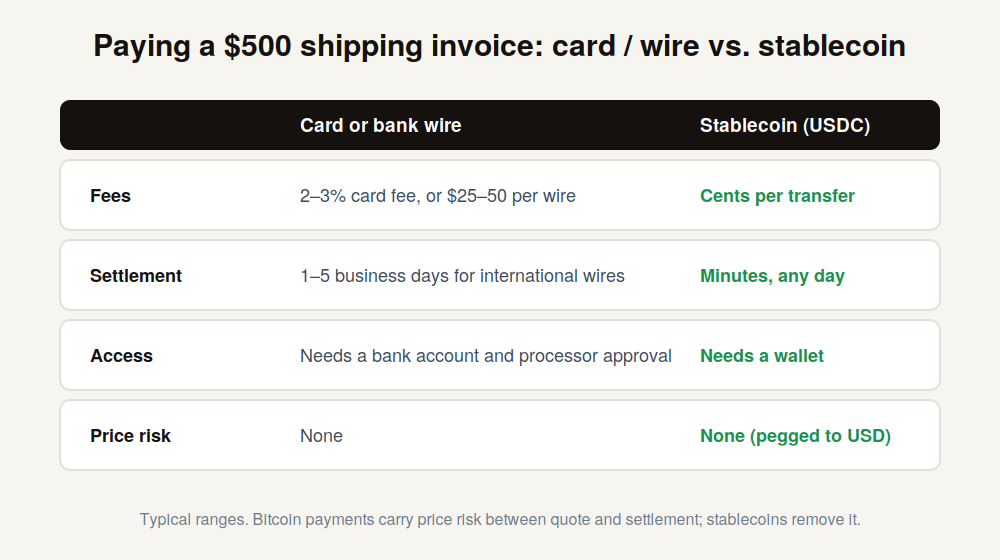
Each of those payments runs through a stack that was not built for it: card networks with 2–3% fees, bank wires that take days and cost $25–50 each, FX spreads on every foreign invoice, and account approvals that can take weeks for a new business. For a company shipping internationally, payment friction is a line item, not an inconvenience.
Crypto rails cut through most of that. A stablecoin transfer settles in minutes, costs cents, works the same in Lagos and Los Angeles, and doesn’t require anyone to open a correspondent banking relationship. That’s the pitch that’s landing with logistics buyers — not “the future of money,” but “your freight forwarder gets paid today and you don’t lose 3% on the way.”
Who is actually paying for shipping in crypto
The early adopters cluster into a few recognizable groups.
Crypto-native businesses. Companies that already hold treasury in stablecoins or Bitcoin — exchanges, NFT and hardware-wallet sellers, Web3 merch stores, mining operations shipping equipment. For them, converting to fiat to pay a carrier is the annoying step. Paying directly removes it.
Cross-border sellers in underbanked markets. A merchant in Nigeria, Argentina or Pakistan selling to US customers often struggles to get a US carrier account or a card that works with US label software. A prepaid label service that accepts USDC or BTC gives them access to commercial USPS and FedEx rates without a US bank account.
Privacy-conscious operators. Small businesses in sensitive categories — security research, adult products, legal cannabis accessories, political or activist merchandise — are routinely dropped by payment processors. Crypto payment for logistics keeps them shipping when their card processor decides they’re too risky.
High-volume shippers chasing margin. For anyone spending six figures a year on postage, a 2–3% card fee is real money. Some label platforms pass part of that saving back as a crypto discount.
The common thread: these are businesses with a concrete problem that crypto solves better than the incumbent. Ideology is rarely part of it.
What the products look like
The emerging category is less exotic than it sounds. Most of these startups sit as a thin layer between the buyer and existing carriers.
Crypto-paid label platforms. Services that resell USPS, FedEx, DHL and Canada Post labels at commercial rates, accept BTC, ETH, LTC, USDC and similar, and generate the label in seconds. USPostage.io is a representative example: an online postage tool where a business tops up with crypto, buys labels for multiple carriers at a discount to counter prices, tracks packages, and integrates with WooCommerce through a plugin. The carrier never touches the crypto — the platform settles with the carrier in dollars and takes the currency risk itself.
Stablecoin freight settlement. Forwarders and freight marketplaces that let importers pay ocean and air freight invoices in USDC, particularly on Asia–Africa and Asia–Latin America lanes where bank wires are slow or unreliable.
Customs and duties payment. Brokers experimenting with stablecoin payment for duties and taxes so importers can clear goods without waiting for a wire to land.
Crypto-integrated fulfillment. 3PLs that accept crypto for storage and pick-and-pack fees, mostly serving Web3 merchants who want a single currency across their whole stack.
The technical innovation is modest. The business innovation is taking a customer segment that incumbents ignore or reject, and building a compliant, dollar-settled service around them.
Why this works now and didn’t in 2017
Three things changed.
Stablecoins removed the volatility problem. Paying a $400 freight invoice in Bitcoin means both sides carry price risk between quote and settlement. Paying in USDC doesn’t. Stablecoins turned crypto from a speculative asset into a payment rail, and most B2B logistics volume in crypto today is stablecoin, not BTC.
Payment processors became more selective. The past few years have seen aggressive de-risking by card networks and processors. Entire categories of legitimate small businesses lost access. Every account closure created a customer looking for another way to pay for the basics — and shipping is about as basic as it gets.
The infrastructure matured. Crypto payment gateways, compliance tooling, and on/off-ramps are now good enough that a small team can launch a crypto-accepting SaaS product without building a treasury desk. The startups in this space are mostly ordinary software companies with an extra checkout option.
The risks investors should price in
This is a real trend, but it’s not a frictionless one.
Regulatory exposure. Any business accepting crypto at scale faces money-transmission, KYC and sanctions-screening questions, and the answers vary by jurisdiction. The winners will be the ones who treat compliance as product, not paperwork. Platforms that lean into “anonymous” as a selling point are taking on regulatory risk that can end the business overnight.
Carrier dependence. Label resellers live on carrier API access and negotiated rates. A policy change at USPS or FedEx can wipe out margin or cut off supply. Diversification across carriers is a survival requirement, not a feature.
Treasury risk. If a platform accepts BTC and settles with carriers in USD, it is running a currency book whether it admits it or not. Well-run operators convert instantly or price in stablecoins; sloppy ones become accidental hedge funds.
Small TAM, for now. The number of businesses that want to pay for shipping in crypto is real but not enormous. This is a wedge, not a market. The interesting question is what the wedge opens up.
What the wedge might open up
The most interesting thing about crypto-paid shipping isn’t the shipping. It’s that these platforms are building payment, identity and settlement relationships with a global base of small merchants that traditional fintech has failed to serve.
A label reseller that knows a merchant’s shipping volume, destinations and payment history is sitting on the data to offer working capital, insurance, duty financing and FX — the same adjacent products that turned Shopify and Square into financial companies. Doing it on crypto rails means those products can be global from day one.
That’s the thesis we find compelling: not “crypto replaces the carrier,” but “crypto lets a software company become the financial layer for merchants the banks won’t touch.” Logistics is just the first product that these merchants can’t live without.
Bottom line
Crypto’s consumer moment never arrived, but its B2B moment is arriving quietly, one shipping label at a time. The startups winning here aren’t selling a vision of decentralized everything. They’re selling cheaper, faster, more accessible payment for something every online business has to buy. That’s the kind of unglamorous product-market fit that tends to compound.